


G20 wraps with no group photo due to Russia's participation
发布: 2026-10-31 20:45
撰文: 無綫新聞


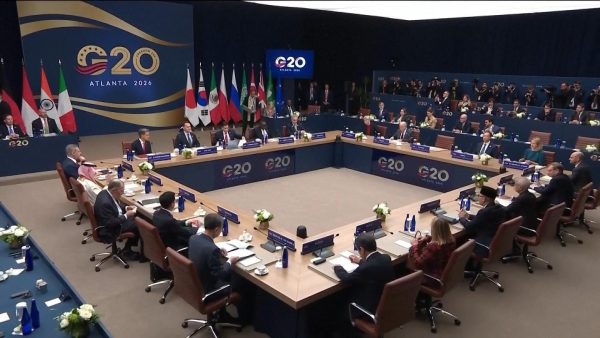
Top diplomats from the Group of 20 largest world economies wrap up two days of talks in Atlanta Saturday without reaching consensus on several critical global security issues.
This after divisions, notably over Russia's war with Ukraine, overshadowed the start of the meeting that has led to the group not releasing a joint communique and a family photo opt scrapped.
They will rely on the chairman's statement to summarise the talks.
Speaking at the G20 Foreign Ministers' Meeting in Atlanta, Georgia, Friday, US Secretary of State Marco Rubio said the world was at a "moment of choosing" warning interconnected economic
and geopolitical crisis posed severe threats to the foundations of the global economic order.
US Secretary of State Marco Rubio said "We are in a critical moment. I would call it a moment of choosing, and I would say not just for my country, the United States of America,
but frankly, for the world. We are facing a series of interconnected economic and geopolitical crisis, as many of which pose severe threats.
Severe threats to essential foundations of the global economic order, new disruptions and strains to global energy and food supplies and food markets,
to the global supply chain, to trade, to freedom of navigation itself."
Rubio called for unity saying "the G20 must work together to confront these threats to strengthen economic resilience, to safeguard markets and economies they sustain."
Rubio held bilateral and trilateral meetings on the sidelines with the Turkish foreign minister and his Saudi Arabia counterpart
and took part in a signing ceremony for the Trilateral Arctic Pacific Partnership Memorandum of Cooperation with the Japanese foreign minister,
but he pulled the plug on the traditional group photo after several European officials threatened to boycott or walk out of the snapshot
that usually kicks off the gatherings due to Russia's participation.
The German Foreign Minister Johann Wadephul said "there will be no group photo showing our European partners together with Mr. Lavrov,"
refering to Russian Foreign Minister Sergei Lavrov, adding "There is no business as usual with Russia."
更多新闻
俄外長出席G20外長會遭歐洲多國杯葛大合照 美國取消相關環節

Trump puts pressure on Kyiv to make deal with Russia
热门新闻


条款及细则
条款及细则
随时随地观看新闻,立即下载


Copyright 2026 TVB Limited