

- 简
- 繁
- En


Rescue drones: Ideal for emergencies | Behind the Wig
发布: 2026-06-15 07:00
撰文: 大律師 / Barristers

Norman Hui
Barrister
Principal Lecturer HKU
Hong Kong stands at a critical juncture in its embrace of drones and the wider low-altitude economy (LAE). Legislative deliberations, public consultations, and dedicated research funding reflect a commendable institutional effort to prepare for this transformation. Yet, the real urgency lies not in technological ambition alone, but in how such developments can directly serve the public, particularly in moments of crisis where time, safety, and access determine outcomes.
Traditional emergency response systems in dense urban environments and where high-rise building rescue operations are involved can be very challenging. “Rescue drones” offer more than innovation since they represent a practical means of saving lives. Equipped with thermal imaging, real-time surveillance, and delivery capabilities, “rescue drones” operating at extreme height can reduce rescue times and shield first responders from unnecessary risk. Such tools would be useful and government policy can enable their timely and safe deployment.
However, the law lags behind necessity. Existing regulatory frameworks are designed for manned aviation that presently struggles to accommodate autonomous and even directly-operated drone systems, particularly when combined with emergency services personnel potentially working with new technology that may eventually include AI-driven operations in dangerous situations.
Hong Kong’s extreme building density presents major drone challenges since severe GPS/satellite signal degradation (caused by “urban canyon effect”), intense electromagnetic interference from thousands of Wi-Fi networks, and strict Civil Aviation Department (CAD) flight restrictions all have an impact on “rescue drones”. Navigating through narrow skyscraper corridors safely remains extremely difficult.
Small drones, particularly those in Category A1 and A2 (generally under 7 kg), are governed under a risk-based regulatory framework that emphasises lower-risk, highly flexible operations. These lighter drones are typically used in “Standard Operations”, requiring compliance with visual line of sight (VLOS) rules, daylight operation, and altitude limits rather than prior approval from authorities. Their relatively light weight and reduced regulatory burden make them especially suitable for rapid deployment in time-sensitive situations, including search and rescue missions, where speed and maneuverability are essential. The framework implicitly supports “rescue drones” in such contexts by minimising existing administrative barriers.
From a functional perspective, these smaller drones offer clear advantages in emergency or rescue environments. Their ability to operate in confined or hazardous areas, such as collapsed buildings, dense urban “canyons” or remote terrain, may be able to deal with operational challenges identified in Hong Kong’s dense urban environment. Unlike larger aircraft, small drones can navigate tight spaces and unstable conditions, making them useful for reconnaissance, victim location, and situational awareness without putting human responders at risk.
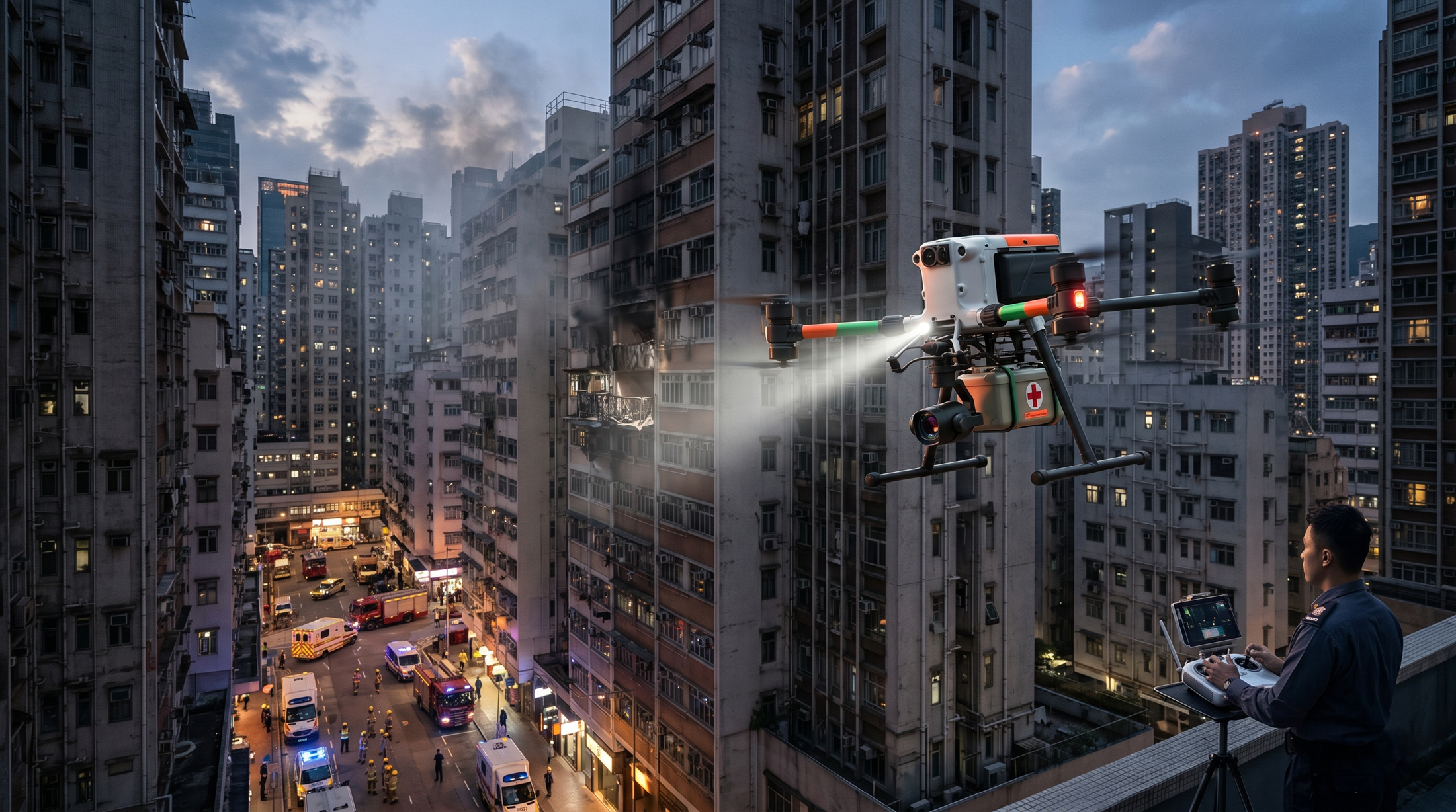
The importance of advanced navigation technologies, such as Light Detection and Ranging (LiDAR), visual systems, and redundancy mechanisms beyond GPS are evolving to assist in future rescue drone deployment. These features are especially relevant to rescue scenarios, where signal disruption or environmental interference may occur. Reliable positioning and obstacle avoidance are critical for drones operating in disaster zones, and the suggested technological standards would enhance the effectiveness of small drones in locating survivors and transporting lightweight emergency supplies.
Safety and communication reliability are further emphasised as essential components of drone operations. There would be a need for secure command-and-control (C2) links, including anti-jamming and anti-spoofing measures, highlights the importance of maintaining stable communication between operators and drones with obvious additions to the law to ensure such operability to be implemented for “rescue drones”. In rescue contexts, where real-time data transmission (e.g., live video or sensor data) is crucial, these safeguards ensure that “rescue drones” can operate effectively even in complex or hostile signal environments, such as disaster-stricken urban areas. Integrating “rescue drones” into a low-altitude economy suggests future scalability for emergency uses and practical application. Developments such as unmanned traffic management (UTM), automated flight systems, and “Unmanned Aerial Vehicle (UAV) highways” would allow coordinated deployment of multiple “rescue drones”. In rescue scenarios, this could enable coordinated swarm operations, rapid area coverage, and real-time traffic management, significantly enhancing response efficiency.
Overall, while not explicitly framed as rescue tools, smaller drones are clearly positioned within the existing or improved regulatory and technological framework as highly suitable assets for emergency response applications.
Given recent events in Hong Kong involving the need for quick emergency aid in high rise environment disasters, the government may want to consider speeding up legislation and related infrastructure to allow for the deployment of “rescue drones” in the near future.
Mr. Norman Hui is Chairman of the Artificial Intelligence and Ethics Committee, Co-Chairman of the Pro Bono Affairs Committee, Member of the Intellectual Property Committee, Personal Injuries Committee and Continuing Education Committee of the Hong Kong Bar Association. His private practice and teaching at the University of Hong Kong are in the same or similar areas of litigation.


Behind the Wig is a weekly legal column written by practicing barristers specialising in criminal, civil, and commercial law. Drawing on their legal expertise and practical experience, or sharing their observations and insights as barristers, they analyse social issues, encourage readers to interpret everyday matters through a legal mindset, and promote the spirit of the rule of law.
The views expressed in this article are the author’s own and do not reflect TVB’s editorial stance.
更多新闻
热门新闻


条款及细则
条款及细则
随时随地观看新闻,立即下载

'%3e%3cpath%20id='路径_2'%20data-name='路径%202'%20d='M579.91,145.916a42.433,42.433,0,1,0,42.528,42.433,41.772,41.772,0,0,0-42.528-42.433m0,68.138a25.8,25.8,0,1,1,23.91-25.705,24.572,24.572,0,0,1-23.91,25.705m-92.9-68.138a42.433,42.433,0,1,0,42.528,42.433,41.772,41.772,0,0,0-42.528-42.433m0,68.138a25.8,25.8,0,1,1,23.911-25.705,24.572,24.572,0,0,1-23.911,25.705m-110.38-55.1v17.956h42.621A37.793,37.793,0,0,1,409.8,199.6a44.037,44.037,0,0,1-33.266,13.135,47.914,47.914,0,0,1,0-95.734,45.836,45.836,0,0,1,32.415,12.854l12.664-12.664a62.75,62.75,0,0,0-45.174-18.144,66.153,66.153,0,1,0,0,131.739,60.2,60.2,0,0,0,45.93-18.9A59.452,59.452,0,0,0,438.154,170.2a58.644,58.644,0,0,0-.946-11.246Zm451.638,14.364a39.409,39.409,0,0,0-36.291-26.933A40.259,40.259,0,0,0,752,188.822a41.49,41.49,0,0,0,42.055,42.432,42.148,42.148,0,0,0,35.344-18.9l-14.459-9.45a24.193,24.193,0,0,1-20.885,11.718,21.546,21.546,0,0,1-20.6-12.852l56.7-23.436ZM770.431,187.5a23.249,23.249,0,0,1,22.21-24.76,16.441,16.441,0,0,1,15.781,9.45Zm-46.023,40.637h18.9V103.577h-18.9Zm-30.525-72.77h-.568a29.385,29.385,0,0,0-22.3-9.449,42.526,42.526,0,0,0,0,85.053,28.908,28.908,0,0,0,22.3-9.449h.663v6.142c0,16.256-8.7,24.854-22.681,24.854a23.431,23.431,0,0,1-21.358-15.12l-16.255,6.71a40.446,40.446,0,0,0,37.8,25.044c21.829,0,40.354-12.853,40.354-44.134V148.468H693.883Zm-21.359,58.594A24.381,24.381,0,0,1,648.9,188.443a24.57,24.57,0,0,1,23.625-25.894,23.909,23.909,0,0,1,22.682,25.894,23.722,23.722,0,0,1-22.682,25.611ZM915.592,103.484H870.985V228.135h18.9V180.883h25.988a38.747,38.747,0,1,0,0-77.4Zm.471,60.1H889.6V120.872h26.461a21.358,21.358,0,1,1,0,42.715m115.012-17.861a34.97,34.97,0,0,0-33.171,18.9l16.539,6.9a17.583,17.583,0,0,1,17.01-9.452,17.958,17.958,0,0,1,19.564,16.066v1.324a41.193,41.193,0,0,0-19.373-4.819c-17.767,0-35.913,9.449-35.913,28.35a28.352,28.352,0,0,0,30.9,27.407,26.277,26.277,0,0,0,23.722-12.191h.661v9.45h17.956v-47.44c-.095-22.115-16.539-34.5-37.9-34.5m-2.268,68.328c-6.047,0-14.552-3.024-14.552-10.585,0-9.45,10.583-13.325,19.751-13.325a33.169,33.169,0,0,1,17.011,4.159,22.588,22.588,0,0,1-22.21,19.751m105.468-65.586-21.357,54.057h-.663l-22.02-54.057H1070.2l33.172,75.6-18.9,42.054h19.374l51.128-117.563ZM966.718,228.135h18.9V103.577h-18.9Zm-840.431-101.5L4.377,4.631A20.131,20.131,0,0,0,.029,18.24V238.72a21.079,21.079,0,0,0,3.4,12.569Zm4.064-3.876,37.8-37.8L25.356,3.214A18.9,18.9,0,0,0,8.912.945Zm89.4-8.695L172.5,87.417l-38.652,39.221,41.3,41.3L219.28,142.8c14.46-7.844,14.46-20.791.472-28.73m-89.4,16.539L7.495,254.974a17.768,17.768,0,0,0,17.768-1.607l144.686-82.219h.566Z'%20fill='%23fff'/%3e%3c/g%3e%3c/svg%3e)


Copyright 2026 Television Broadcasts Limited